
Fionn Mac Cumhaill (Finn McCool)
Fionn Mac Cumhaill, often anglicized as Finn McCool, is one of the great heroes of Irish mythology. He is the central figure in the Fenian Cycle, a body of stories about Fionn and the Fianna, a celebrated band of warriors, hunters and poets. The tales survive in medieval manuscripts and in a rich oral tradition that developed over many centuries in Ireland, Scotland and the Isle of Man.

Fionn’s Early Life
According to The Boyhood Deeds of Fionn, he was the son of Cumhaill, leader of the Fianna, and Muirne. His childhood name was Demne. After Cumhaill was killed by Goll mac Morna at the Battle of Cnucha, the boy was placed in the care of the warrior women Bodhmall and Liath Luachra. Tradition says they raised him secretly in the forests of the Slieve Bloom Mountains, where he learned to hunt, run, swim and use weapons.
The name Fionn means “fair,” “white” or “bright.” The stories describe how the gifted young Demne acquired this name and gradually became a warrior, poet and leader whose wisdom was as important as his physical strength.
The Salmon of Knowledge and the River Boyne
One of Fionn’s best-known adventures connects him directly with the River Boyne. As a boy, he was sent to learn poetry and science from a poet and seer named Finn Éces, also known as Finnegas or Finnéigeas, who lived beside the river. In those waters lived the Bradán Feasa, the Salmon of Knowledge. Whoever ate the salmon would enjoy all the wisdom of the ages.
Finn Éces had been trying to catch the salmon for years. Tradition says he sought it for seven years. The fish was said to have gained its knowledge by eating hazelnuts that fell from nine magical hazel trees into a well of wisdom. At last he managed it. He gave the salmon to Fionn to cook, warning him not to eat any of it.
While cooking the fish on an open fire, Fionn burnt his thumb. Without thinking, he sucked his thumb to ease the pain. When Finn Éces returned, he saw the glow of wisdom in Fionn’s eyes. “Take the Salmon of Knowledge and eat it,” said Finn Éces to Fionn, “for in you the prophecy is come true. Go hence, for I can teach you no more.”
From then on, Fionn could draw upon extraordinary insight by placing his thumb in his mouth. Details vary among versions of the tale, but the Salmon of Knowledge remains one of Ireland’s most enduring stories about wisdom, inspiration and destiny.
Áillen and the Hill of Tara
 Aerial view of the Hill of Tara.
In another famous episode, the supernatural being Áillen came to the Hill of Tara each year at Samhain. He lulled its defenders to sleep with enchanted music and then burned the royal residence. Fionn resisted the spell with the aid of a magical spear, defeated Áillen and saved Tara. In recognition of his victory, he was granted leadership of the Fianna, restoring the position once held by his father.
From Warrior Hero to Landscape Giant
In the earlier Fenian tales, Fionn is a heroic warrior, hunter, poet and leader. In later folklore he often became a giant whose actions shaped the landscape. The Giant’s Causeway was said to be his pathway toward Scotland, while one story claims that the Isle of Man was formed from a piece of earth he threw into the Irish Sea. These colorful traditions helped attach Fionn’s name to natural features and ancient monuments across Ireland and the wider Gaelic world.
A later sleeping-hero tradition says that Fionn and the Fianna are not dead but lie beneath Ireland, ready to return in a time of great need when the Dord Fiann, Fionn’s hunting horn, sounds three times.
Proleek Dolmen
Local folklore links the Proleek Dolmen in County Louth with a Scottish giant named Para Buidhe Mór Mhac Seoidin. He is said to have carried the dolmen’s great stones from the nearby mountains before challenging Fionn to combat. In one version of the story, Fionn poisoned a nearby river; the giant drank from it, died and was buried in the wedge tomb close to the dolmen.
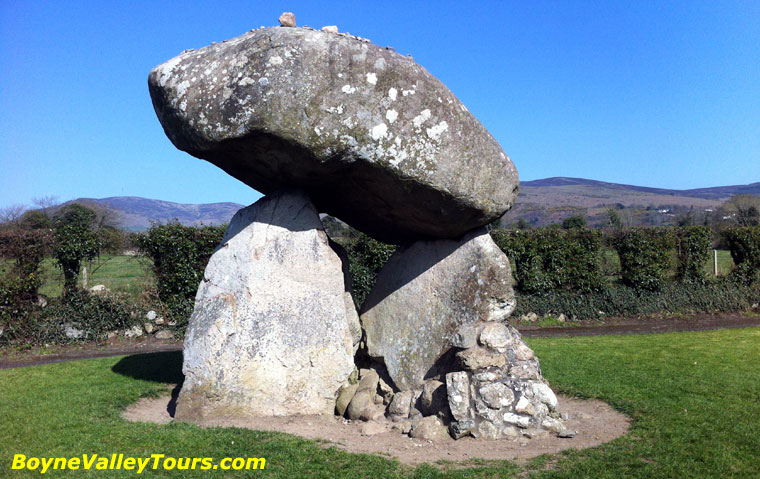 Proleek Dolmen, County Louth, associated in local folklore with Fionn Mac Cumhaill and a defeated Scottish giant.
The Jack Stones at Greenanstown
The Jack Stones at Greenanstown, County Meath, are another example of Fionn’s presence in local folklore. One story says he threw the great stones from the Hill of Tara. Another says that Fionn tossed them over his house, ran around the building and caught them before they touched the ground. Versions of this tradition were recorded in the National Folklore Collection’s Schools’ Collection during the 1930s.
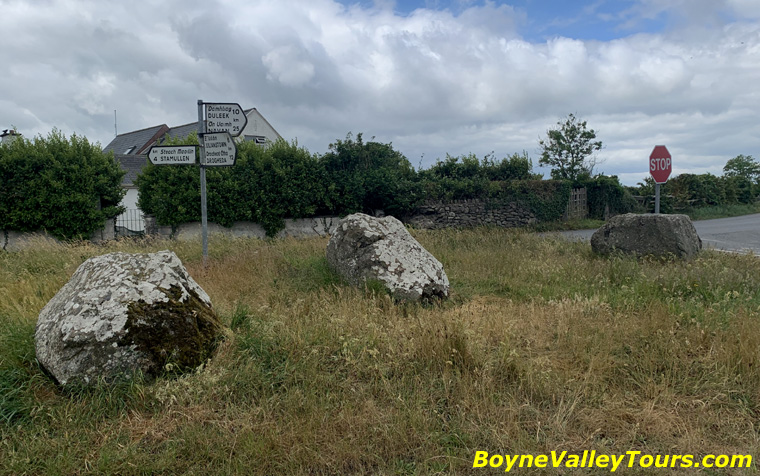 The Jack Stones - Greenanstown, Co. Meath.
Fionn’s Enduring Legacy
Fionn’s stories were never confined to a single text or place. Medieval writers, Gaelic storytellers and generations of local tradition continually reshaped them. His companions, including Oisín, Oscar, Caílte, Diarmuid and Goll mac Morna, became leading figures in their own tales, while landmarks throughout the Boyne Valley preserve memories of Fionn in the landscape. Today these stories add another layer to a region already renowned for its prehistoric monuments, royal sites and medieval heritage.
TripAdvisor Review
We spent a full day with Michael visiting the ancient sites. He is a walking encyclopedia and covered a wide range of topics across Irish history. He is friendly and kept us engaged. Read the full TripAdvisor review